
Speak to us today 0800 4488 593
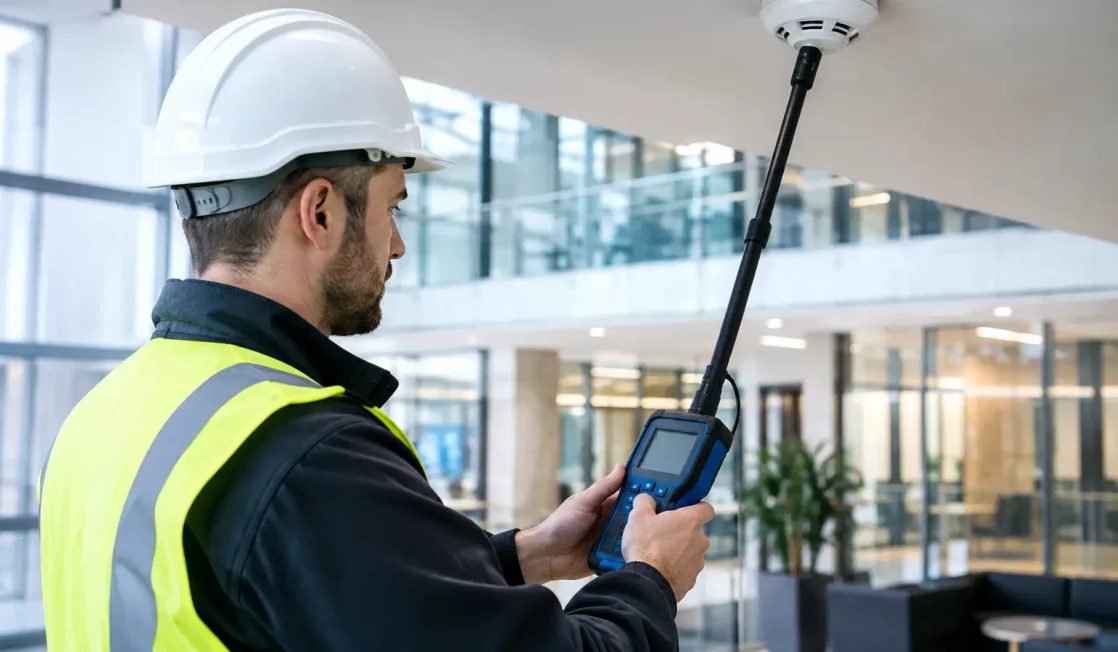
Who needs BS 5266 testing? In practical terms, the person or organisation responsible for a non-domestic building with emergency lighting needs to ensure it is inspected, tested and maintained. That commonly includes facilities managers, managing agents, commercial landlords, business owners, estates teams and public-sector dutyholders. The requirement is not simply to operate test switches: it is to make sure emergency lighting will support safe evacuation if normal lighting fails.
BS 5266 is the British Standard series covering emergency lighting. For most commercial dutyholders, BS 5266-1 is the principal code of practice for the design, installation and verification of emergency escape lighting. Routine inspection and testing are also informed by the relevant parts of the BS 5266 series and BS EN 50172.
British Standards are not legislation in themselves. However, they are widely used as a recognised benchmark for showing that emergency lighting has been designed and maintained appropriately. In England and Wales, the Regulatory Reform (Fire Safety) Order 2005 requires the responsible person to take general fire precautions, maintain fire safety measures where necessary, and keep appropriate records. A suitable fire risk assessment should identify whether emergency lighting is required and the level of provision needed.
For premises in Hertfordshire, London and the Home Counties, the responsible person may be the employer, building owner, landlord, managing agent or another party with control over the premises. Lease terms and management agreements can allocate day-to-day tasks, but they do not remove the need for clear accountability.
Testing is relevant wherever emergency lighting has been installed, whether it is a small maintained system above escape doors or a substantial central battery installation serving a large site. The purpose is to confirm that luminaires, signs, batteries, chargers and controls remain capable of operating during a loss of normal supply.
Commercial offices, warehouses, factories, retail units, schools, healthcare settings, communal areas of multi-occupied buildings and managed industrial estates will often have emergency lighting. The precise requirement depends on the building layout, occupancy, risk profile, escape routes, availability of daylight and the findings of the fire risk assessment.
Particular attention is usually needed in areas where a lighting failure could make evacuation difficult or create an immediate hazard. These can include staircases, changes of direction, final exits, corridors, open-plan spaces, plant rooms, windowless rooms, external escape routes and areas containing fire-fighting or first-aid equipment. High-risk task areas may require a different standard of emergency lighting from ordinary escape routes.
A building does not stop needing testing because it is lightly occupied, partly vacant or used only during daytime hours. Equally, not every room needs the same type or duration of coverage. A competent assessment should consider how people would leave safely in the actual circumstances of the premises.
The responsible person for fire safety should make sure a suitable testing and maintenance regime is in place. Within larger organisations, this work may be administered by a facilities manager or estates team and delivered by a competent contractor. Managing agents may coordinate access, records and remedial works on behalf of the owner or landlord.
The critical point is that responsibility should not be left unclear between occupier, landlord and agent. In multi-let buildings, for example, common escape routes may sit with the landlord or managing agent, while individual tenants are responsible for their own demise. The emergency lighting system may cross those boundaries, so testing arrangements need to reflect the actual system design and responsibilities.
Procurement teams should also look beyond the price of a routine visit. The provider needs enough information about the building, system type, occupancy and operational constraints to scope the work safely. Testing a central battery system, for instance, is different from checking a small number of self-contained emergency luminaires.
Emergency lighting testing normally combines visual inspection, functional testing and periodic full-duration testing. A brief functional test checks that fittings change to emergency operation when the normal supply is interrupted or a test facility is operated. A full-duration test checks whether the system can operate for its designed emergency period.
The exact programme should follow the system design, manufacturer instructions, risk assessment and applicable standards. Monthly function tests and annual full-duration tests are common elements of planned maintenance, but they should not be treated as a substitute for a site-specific regime. Some systems need additional checks, while the timing and duration of tests may need careful management around building use.
Testing can reveal more than a failed lamp. Common findings include depleted batteries, damaged diffusers, missing or poorly positioned exit signs, faulty charging indicators, unlabelled test keys, obsolete fittings, circuit faults and changes to the layout that have compromised coverage. A fitting that illuminates briefly is not necessarily capable of meeting its full rated duration.
For central battery systems, the inspection may also consider the battery condition, charger status, distribution equipment, monitoring arrangements and integrity of the circuits supplying emergency luminaires. These systems can support wider areas and larger buildings, but faults may affect multiple escape routes at once.
A full-duration test deliberately places emergency lighting on battery supply. Depending on the system, batteries may need time to recharge before they can provide their designed duration again. Carrying out a test at the wrong time can therefore reduce resilience during normal operating hours.
Facilities teams should plan testing around occupancy, security, shift patterns, care provision, teaching schedules and critical operations. In healthcare, education, industrial and multi-site environments, this may involve agreeing access arrangements, identifying sensitive areas and establishing what happens if defects are found during the visit.
A competent contractor should also avoid creating unnecessary disruption. The aim is to verify safety without causing avoidable downtime, nuisance alarms or confusion for occupants. Where a test affects areas with critical processes, the maintenance plan may need to coordinate with other building systems and operational stakeholders.
Emergency lighting records are as important as the test itself. A logbook, whether physical or digital, should show the system details, test dates, test type, results, defects identified and corrective actions taken. It should also record who carried out the work and when outstanding issues were resolved.
For larger sites, clear asset identification is valuable. A numbered schedule of luminaires and exit signs makes recurring inspections more consistent and helps facilities teams understand whether faults are isolated or recurring. It also supports budgeting for ageing assets, battery replacement programmes or wider upgrades.
Testing records should sit alongside the fire risk assessment and wider fire safety documentation. They are not interchangeable. A fire risk assessment considers the fire precautions required for the premises; emergency lighting test records demonstrate whether the installed system has been checked and maintained.
It is also worth distinguishing emergency lighting documentation from an Electrical Installation Condition Report, or EICR. An EICR assesses the condition of fixed electrical installations against the requirements applicable to the installation. It does not replace the planned functional and duration testing required for emergency lighting. Likewise, a remedial works certificate records corrective work completed; it does not retrospectively alter the observations made on an earlier EICR.
Any defect that affects an escape route, exit sign or the system’s ability to provide emergency illumination should be assessed promptly in the context of the fire risk. The right response depends on the nature, extent and location of the fault. A failed fitting in a low-risk area may require planned replacement, while widespread battery failures or missing coverage on a main escape route may need urgent action and interim risk controls.
Older systems can present a broader issue. Repeated battery failures, unavailable lamp types, inconsistent fitting styles and building alterations may point to the need for a planned upgrade rather than piecemeal repairs. LED emergency lighting can reduce routine lamp replacement and improve consistency, but any replacement should be designed for the building rather than selected solely on unit cost.
For commercial portfolios, trend information is particularly useful. Recurring faults at several sites may indicate poor asset condition, unsuitable fittings or gaps in maintenance planning. A structured compliance programme makes those patterns easier to identify before they become a larger capital or safety issue.
Start by confirming who holds responsibility for emergency lighting in each area of the building, then review the available drawings, logbooks, previous test results and fire risk assessment. If records are incomplete or the system has changed following refurbishment, an inspection can establish the condition of the installation and the work needed to return it to a manageable maintenance regime.
Whitton Electrical supports commercial clients with emergency lighting inspection, testing, remedial works and planned maintenance. For a building, estate or multi-site portfolio, a clear scope and reliable records provide a stronger basis for safe decisions than assuming a test button alone proves compliance.